Four cities on hold: is Solana’s persistence in China worth the cost?
Information cut-off stated in the source: 17 October 2026. This is an industry feature; facts and opinions are presented separately. It does not constitute investment advice.
RWA Space editorial introduction: From the quiet cancellation of the Hongqiao event in March, to the prominent illumination of Shanghai’s waterfront in October, and then, within a week, the halt in Shanghai, postponements in Hangzhou and Shenzhen, and what the original account describes as a cancellation in Beijing: Solana’s China initiative has come full circle. This article looks beyond the immediate headlines to an older question. When something is difficult, should one stop, or persist precisely because it is difficult? Which approach deserves to be called a first-mover advantage?
1. Four cities, all on hold within a week
First, the timeline.
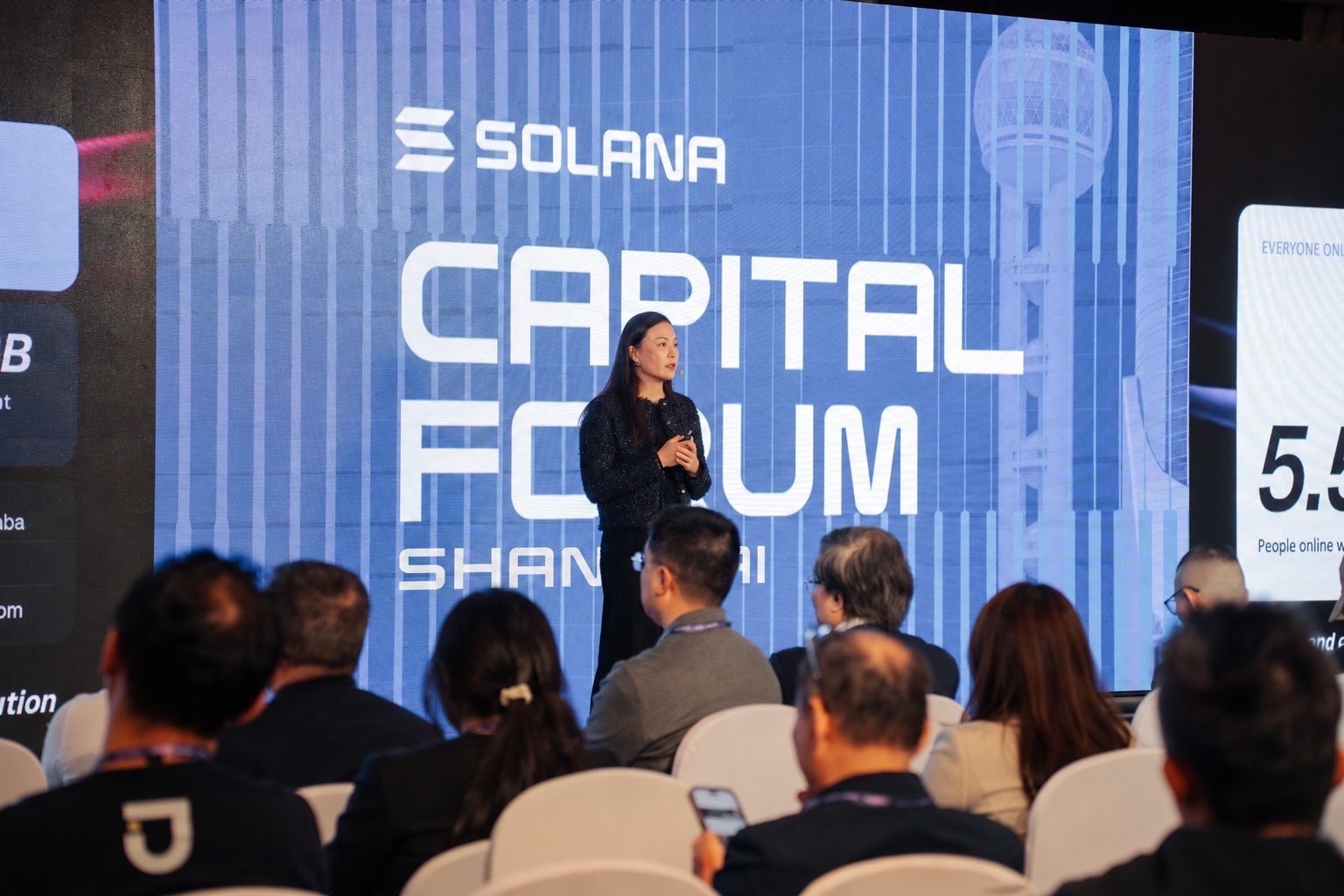
On the evening of 14 October, the Citi building in Lujiazui was illuminated with a purple-and-blue SOLANA logo. A new office in Shanghai Tower was unveiled at the same time, and a four-city Accelerate tour was announced: Shanghai on the 16th, Hangzhou on the 18th, Shenzhen on the 20th and Beijing on the 22nd.
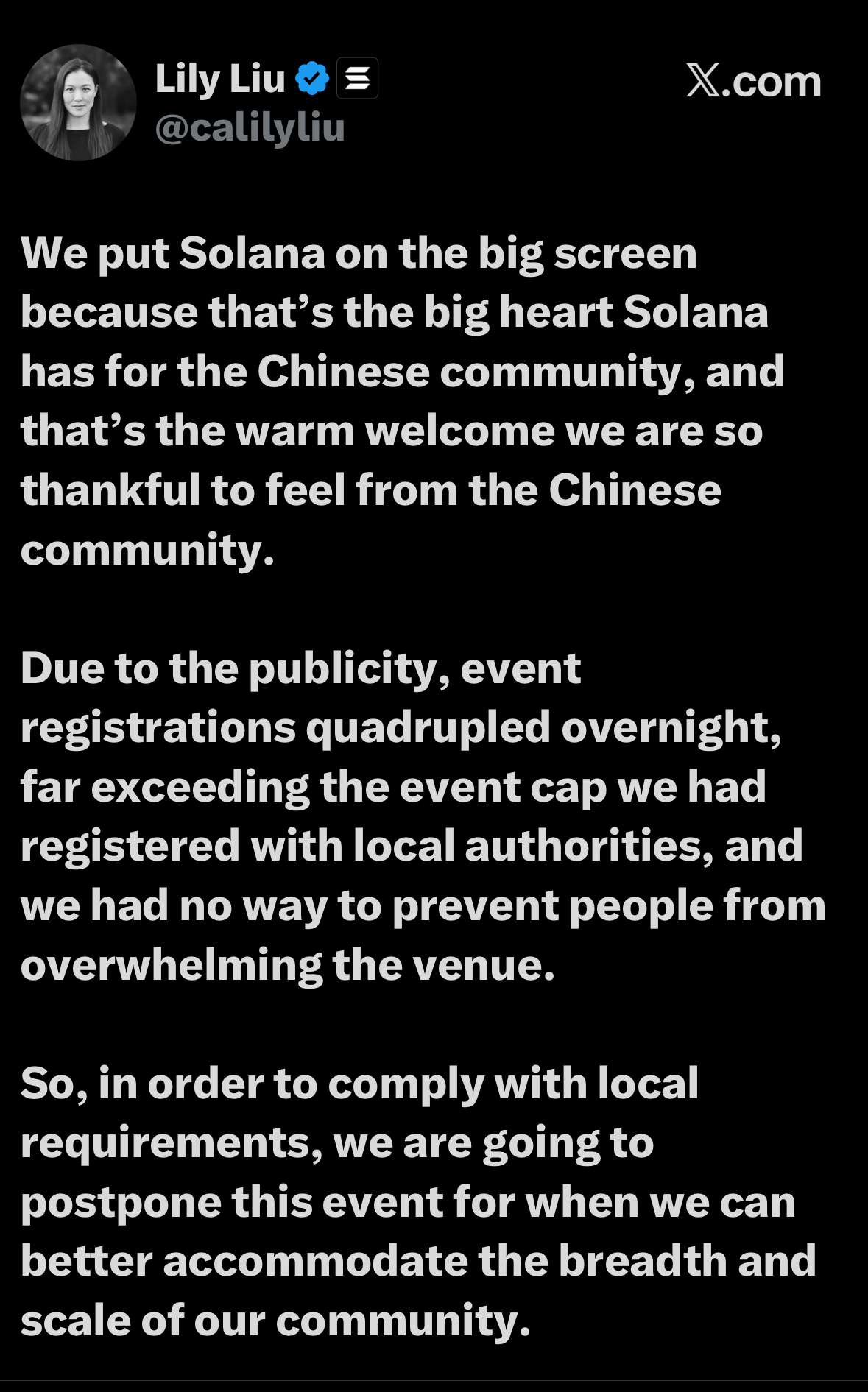
On the morning of 16 October, the Shanghai event failed to open as scheduled. Attendees waited outside for more than an hour; several said they had seen approximately eight or nine people who appeared to be law-enforcement personnel. That evening, Solana Foundation president Lily Liu explained on X that registrations had quadrupled overnight, far exceeding the attendance limit notified to the local authorities, and that the event was being postponed to comply with local requirements.
On 17 October, the Hangzhou event, originally scheduled for the 18th, and the Shenzhen event, scheduled for the 20th, were postponed. Revised dates were to be announced, and existing registrations would remain valid.
The original account describes the Beijing event, scheduled for the 22nd, as having been cancelled on 17 October. The email from the Solana Accelerate China team used the more restrained wording of postponement: “Due to oversubscription to the event and in order to comply with local event guidance, we are postponing the program on the 22nd until further notice.” It cited oversubscription and compliance with local event guidance. Its final sentence read: “More importantly, we look forward to seeing you in Beijing soon.”
Four cities. One week. All on hold.
Solana Accelerate Beijing email, described in the original as a cancellation notice
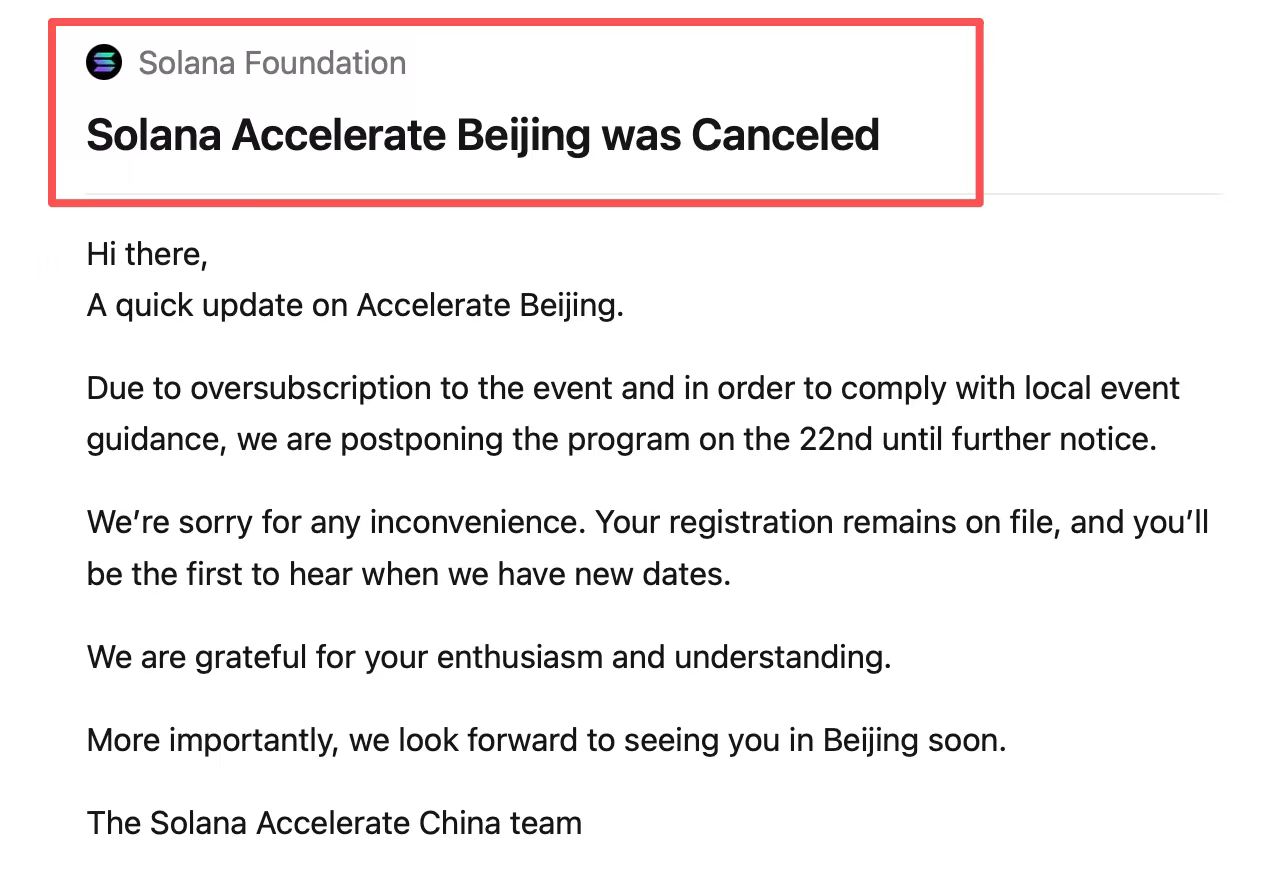
Solana Foundation Solana Accelerate Beijing was Canceled Hi there, A quick update on Accelerate Beijing. Due to oversubscription to the event and in order to comply with local event guidance, we are postponing the program on the 22nd until further notice. We’re sorry for any inconvenience. Your registration remains on file, and you’ll be the first to hear when we have new dates. We are grateful for your enthusiasm and understanding. More importantly, we look forward to seeing you in Beijing soon. The Solana Accelerate China team
The screenshot headline says “Canceled”; the body says the programme is postponed until further notice. The original uses both terms.
Image: The Solana Accelerate China team’s email concerning the Beijing event, described in the original as a cancellation notice. Source: Solana Foundation email notification.
2. This was not the first attempt
Take a step back: another initiative had already been scheduled earlier in the year.
In March, Solana planned to establish a Builder Station in Shanghai’s Hongqiao district: a permanent space for developers. Shortly after the plan became known, the event was quietly cancelled, without an official explanation. Community discussion faded after a couple of days.
At the time, most people interpreted the outcome as a sign that the moment had not yet arrived.
Ten months later, in the original article’s phrasing, the moment had “arrived”: an office in Shanghai Tower, illuminated branding on the waterfront, and a four-city tour on the calendar. Even Changpeng Zhao reposted the news, saying, “BNB Chain has yet to achieve this.” Then, within a single week, the in-person events were back at square one.
Compared with the earlier episode, this one at least left a written explanation: registrations had exceeded the notified attendance limit. The author’s inference is worth pausing over: an excess over a notified limit suggests that a notification had been made; that notification, in turn, suggests that the initiative had been allowed to proceed for some distance. On this reading, the problem was that the speed at which its visibility spread exceeded the boundaries set when the event was notified.
3. Competing voices, each with a point
Over the past few days, the community has split into opposing camps.
One view is that the outcome should have been anticipated. Its proponents point to the mainland’s Document No. 42, which the source describes as expressly prohibiting exchanges between fiat money and virtual currencies. They also cite an earlier Shenzhen event that, according to the source, ended prematurely on public-safety grounds in October 2025. Less than a year later, the argument goes, the same mistake was being repeated. “Do they really understand local policy?” was the question the article attributes to Changpeng Zhao, who a week earlier had praised Solana’s willingness to promote itself in China. For the cautious camp, the episode vindicated a longstanding judgement: the greater the visibility, the closer the regulatory boundary.
Another view is that the problem lay in the scale of the publicity, rather than the direction of the initiative. The agenda covered Qwen Agent, robotics, embodied intelligence and stablecoin payments, rather than token speculation; engineers outnumbered traders. In this interpretation, a technical event halted because it attracted too many registrations is not evidence of an enforcement action for misconduct. It looks more like popularity that outgrew the organisers’ ability to contain it.
A third voice is quieter, and easier to overlook: the disappointment of developers. An engineer registered for the Hangzhou event wrote in the community: “I printed out the agenda. I was planning to go to Hangzhou on Saturday. Now all I can do is wait for the next email.” For these participants, narratives and competing positions matter less than when a broken connection to the global ecosystem will be restored.
All three positions have merit. The disagreement partly reflects different questions: one group is debating policy boundaries, another the practical scale of an event, and a third simply wants a meeting to take place.
4. The value of persistence: sacrifice or a wager on a dream?
That brings us to the uncomfortable question.
Knowing the regulatory stance in this market, Solana nevertheless made three attempts to establish a presence: Hongqiao, Shanghai and the four-city tour. Is that recklessness, or persistence?
Sceptics call it recklessness: a Swiss foundation directing the cadence of its China publicity from across the Pacific, becoming a compliance-risk case study and leaving ecosystem partners hesitant to commit.
Supporters call it persistence. For a blockchain they rank among the world’s top two, leaving the largest pool of engineers and a major hardware supply chain out of its growth strategy would leave a foundation stone missing from its vision of “internet capital markets”. The source invokes a saying it attributes to Einstein: repeatedly doing the same thing while expecting a different result is insanity. It argues that Solana is doing the opposite: each setback is followed by another attempt, approached differently.
Perhaps there is no first-mover advantage without persistence. The article argues that when Hong Kong’s licensing regime took effect in 2024, the institutions that positioned themselves first captured the full market upswing. Teams that had established settlement networks across Asia before interest in stablecoins intensified in 2025 now occupy positions that others envy. Such an advantage is not acquired by waiting; it emerges through incremental experimentation within the boundaries the rules permit.
The other side of the argument is equally valid: whether the effort is worthwhile must be tested. Persistence has a cost. Every setback consumes credibility, team morale and community patience. After four cities were put on hold, the next question is less whether to return than how: less publicity, smaller events, and closed-door developer days in place of public gatherings. That route may still be viable, even if it is less glamorous.
5. Musk and the operating environment: a stark comparison
At this point, one comparison is difficult to avoid.
The original commentary gives the following account of a demonstration on the evening of 15 October, the day before the Shanghai halt, at SpaceX’s test site in McGregor, Texas. A white Roadster drove up an almost vertical ramp, hung upside down, then flipped through the air over five vehicles—a Cybertruck, Semi, Cybercab, Model Y and Model 3—before landing on all four wheels. It says an Optimus robot, rather than a person, occupied the driver’s seat, and that the recorded 0–60 mph time was 0.81 seconds. According to this account, Musk asked the audience to stand as witnesses that the demonstration was not AI-generated video. The car had been delayed for nine years, with delivery moving from 2020 through to 2026; even the demonstration itself had reportedly been postponed for two weeks because of high winds.
The article describes the footage as dominating online discussion that evening, with reactions along the lines of: “They have actually achieved something we could not imagine.” It attributes a widely circulated repost to Nio’s William Li: “Incredible! This is something we really do not have.” Eight years earlier, it recalls, he had said: “We have everything Tesla has.”
Both stories involve initiatives that are poorly understood, repeatedly challenged and deeply controversial. Yet Musk’s SpaceX can ignite another rocket after a succession of explosions. The FAA sets aside restricted airspace; capital markets supply further funding; technical failures become lessons rather than occasions for assigning blame. In the author’s comparison, permission from the surrounding environment underwrites that persistence: failure is an engineering problem, rather than a threat to continued existence. The Roadster could be delayed for nine years without anyone having to submit a self-criticism; a one-day postponement in Shanghai required the foundation president to issue an overnight statement.
Solana’s team in China, by contrast, must first ask whether each attempt is permitted, and hope that each success does not spread too quickly. The same persistence has a very different chance of survival in these two environments: in one, failure leaves room for another attempt; in the other, it can end the story.
The author extends the comparison to the scale of capital markets.
The source cites Bloomberg figures placing the combined market capitalisation of US-listed companies on the NYSE and Nasdaq at approximately US$75 trillion as of April 2026, exceeding the combined total of the nine markets ranked second to tenth. It places China second at US$14.84 trillion: a substantial figure, but only about one-fifth of the US total, and roughly comparable to Japan’s US$8.19 trillion plus Hong Kong’s US$7.41 trillion. The historical comparison is more striking: US market capitalisation of US$15.6 trillion and China’s US$3.4 trillion in 2011. Over 15 years, the source says, the US total grew almost fivefold and China’s more than fourfold, while the absolute gap widened from approximately US$12 trillion to US$60 trillion.
Total market capitalisation of the world’s ten largest stock markets
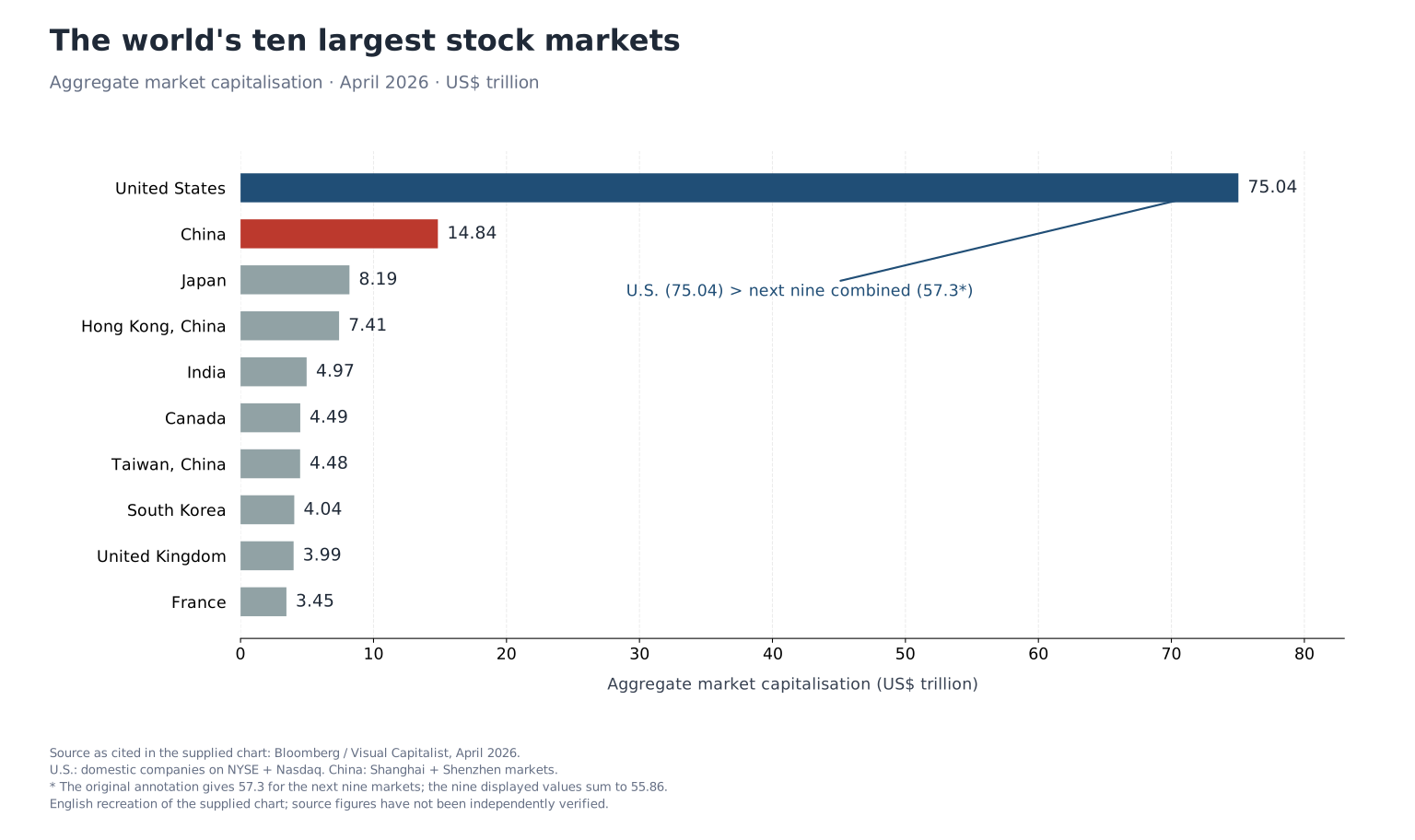
Aggregate market capitalisation · April 2026 · US$ trillion
United States: 75.04; China: 14.84; Japan: 8.19; Hong Kong, China: 7.41; India: 4.97; Canada: 4.49; Taiwan, China: 4.48; South Korea: 4.04; United Kingdom: 3.99; France: 3.45.
Original annotation: United States (75.04) > next nine markets combined (57.3). The original annotation gives 57.3 for the next nine markets; the nine displayed values sum to 55.86.
Source as cited in the supplied chart: Bloomberg / Visual Capitalist, April 2026. U.S.: domestic companies on NYSE + Nasdaq. China: Shanghai + Shenzhen markets.
English recreation of the supplied chart; source figures have not been independently verified.
Image: Comparison of total market capitalisation across the world’s ten largest stock markets. Data attributed in the source to Bloomberg, compiled by Visual Capitalist, April 2026.
Market capitalisation measures only one aspect of scale. Global reach is another. Apple, Microsoft, Nvidia, Amazon and Alphabet regularly feature among the world’s ten most valuable companies; the source notes that mainland Chinese companies have been absent for years. China’s A-share market has long ranked second by aggregate listed-company value, making it a major centre by size. Yet the number of globally influential companies it produces is not commensurate with that scale. The reasons are complex: market structure, the capital account and geopolitics could each fill a book. One factor, however, resembles the issue in Solana’s story. Scale can grow within a market; global reach requires venturing beyond it, and that requires room to experiment and make mistakes. When every attempt to cross a boundary carries prohibitive costs, the most rational choice becomes growing large within the walls, rather than competing to lead beyond them.
That outcome is shaped by the environment as well as by companies’ choices. The environment itself accumulates through countless decisions about how to handle a particular case. The way the Shanghai halt was communicated, the wording of the Hangzhou and Shenzhen postponements, and the Beijing email described as a cancellation each offer a sample of that environment.
There is another side to the comparison. The source says the Roadster could not be driven on public roads after the demonstration, that production was not due until 2028, and that a robot sat in the vehicle. It also attributes to Musk the warning that the car “may not prioritise safety”. In contrast, it puts China’s new-energy-vehicle production and sales in 2025 at 16.626 million units, ranking first globally for an eleventh consecutive year, and complete-vehicle exports at 7.098 million units to more than 100 countries. Delivering at scale and staging a remarkable demonstration are different capabilities. The former also demands substantial engineering and management expertise; Musk, the source notes, has repeatedly acknowledged on earnings calls that his strongest competitors come from China. The two capabilities do not, however, translate into global influence at the same rate.
6. Light through a partly open door
Finally, a more personal reflection.
For a publication covering real-world assets and onchain ecosystems, this is a difficult story to write. We want local technical communities to connect more freely with global networks. We want an engineer’s Saturday afternoon to be spent at an open technical discussion, rather than waiting for a rescheduling email that may never arrive.
It is also necessary to acknowledge that this outcome was more measured than the worst-case scenario. There was no public reprimand, no associated penalties and not even an instruction framed as an order—only an English email saying, “we look forward to seeing you in Beijing soon”. In the author’s view, an event that was notified to the authorities and then paused because it attracted excessive demand occupies a very different position from one that was never permitted. The former suggests a door left slightly open; the latter would leave little room for hope.
The author expects Solana to return, with smaller venues, less publicity and a more cautious communications strategy. Persistent people rarely lack the courage to try again; what they need is patience from the environment around them.
When will the lights come on again? Nobody knows. What remains, the article argues, is the community behind them: engineers, developers and the tens of thousands of people who registered for the four-city events. As long as the people remain, the ecosystem remains.
First-mover advantages do not reward those who only watch.
Produced by RWA Space. The original article states that its factual passages draw on public reporting and official statements, including the Solana Accelerate China team’s email, Lily Liu’s statement on X, and reporting by Odaily, Tencent News, Cointelegraph and the South China Morning Post. It presents opinions separately from facts and asks readers not to use the article as a basis for decisions.
Professional English adaptation of the supplied commentary, whose stated information cut-off is 17 October 2026; that cut-off is not evidence of its original publication date. The source’s claims, estimates, quotations, legal characterisations and reported events—including the Roadster demonstration and market figures—have not been independently verified in this adaptation. Quotations originally supplied in Chinese are translated here; the quoted Beijing email retains its supplied English wording. The source calls the Beijing event a cancellation, while its quoted email says postponed until further notice; those descriptions remain distinguished. This is a complete editorial adaptation for review, not a new verification of the underlying account or investment advice. The publication date displayed separately was supplied by the site owner. The stock-market chart is recreated with English labels and the same figures; original documentary images remain as supplied, with English transcriptions of Chinese wording where needed.