
The Seven-Cent War: Circle’s Distribution Economics Under Pressure on Three Fronts
Data basis: Circle’s Q2 2026 earnings disclosures and SEC Form 10-Q, submitted on August 5, 2026; official company announcements; and reports from the U.S. Congressional Research Service (CRS). This industry feature distinguishes reported information from editorial judgments and does not constitute investment advice.
RWA Space editorial introduction: For every dollar of revenue Circle earns, 59 cents goes to distribution partners and transaction costs, 34 cents is spent on operations and infrastructure, and seven cents remains as net profit. That is the allocation Circle set out publicly on October 16, according to the supplied commentary. How long can this arrangement hold? Our answer has two parts: retained economics are improving in the accounts, but the competitive playbooks described over the preceding week have all become more ambitious. Tether is strengthening institutional access; new issuers are pushing channel revenue-sharing to its limit; J.P. Morgan brought its deposit token to Ethereum mainnet on October 19, according to the announcement cited in the original; and platforms such as Stripe are positioning themselves further upstream than settlement. The seven-cent war is no longer a contest between two issuers for outstanding balances. It is a three-and-a-half-sided struggle over the distribution of value among issuers, channels, banks and procurement platforms.
1. Follow the dollar: where Circle’s revenue goes
The SEC Form 10-Q figures cited for the second quarter of 2026 put total revenue at approximately $701 million, including about $668 million in reserve income, or 95.2% of the total. Distribution, transaction and other costs were approximately $412 million, while net income from continuing operations was approximately $48.21 million.
One line item stands out: Coinbase-related distribution costs of $324.6 million, equivalent to approximately 48.6% of the quarter’s reserve income. The percentage is the original article’s calculation from the cited 10-Q figures. Circle earns interest on reserves, but nearly half of that interest is spent securing something else: channels’ willingness to promote USDC.
In the October 16 blog post cited in the original, Circle condensed the structure into a simple allocation: approximately 59 cents of each revenue dollar goes to distribution partners and transaction costs, 34 cents to operations and infrastructure, and seven cents becomes net profit. This is the company’s summarized presentation; the 34 cents should not be interpreted as “compliance spending” alone.
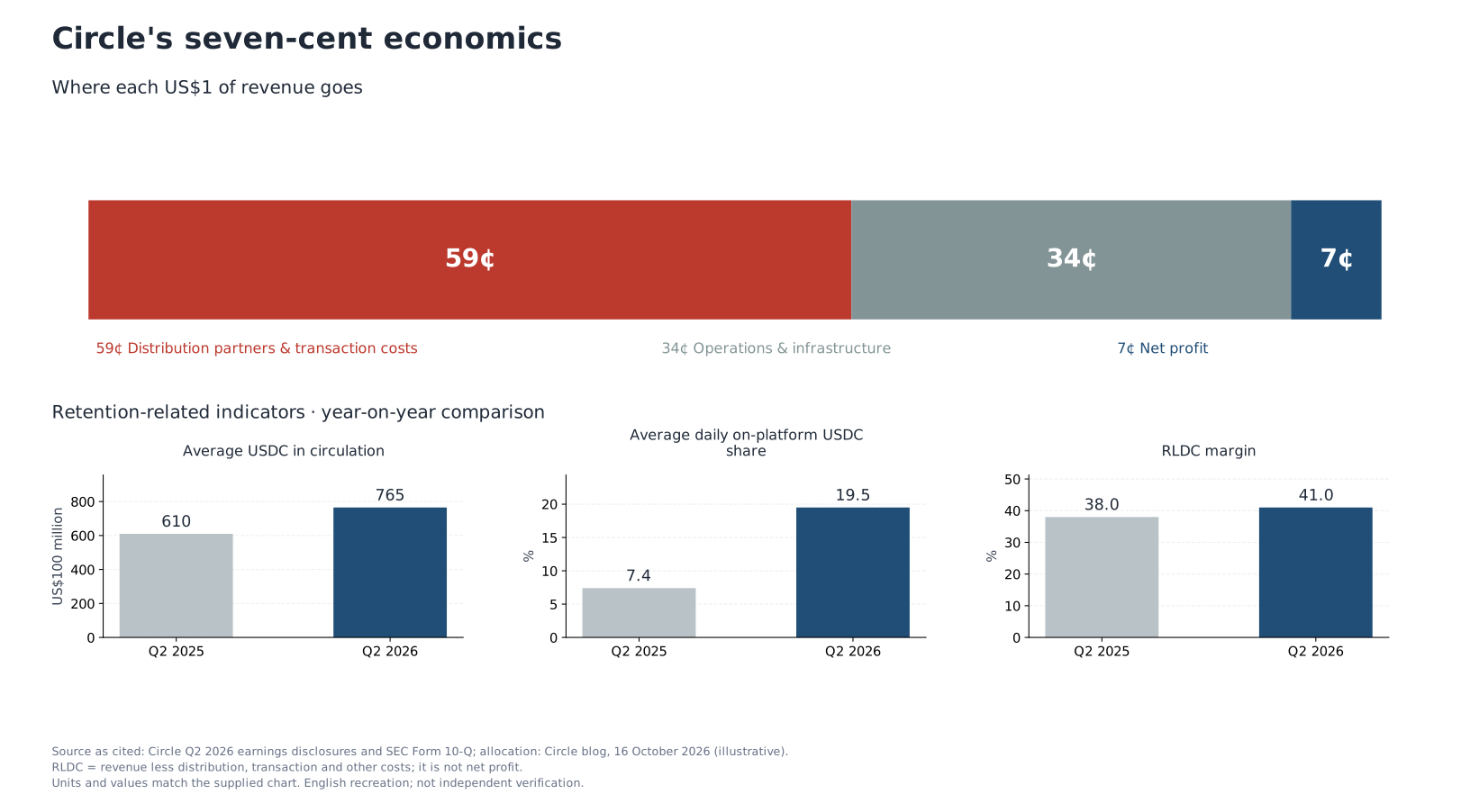
Where each US$1 of revenue goes: Distribution partners & transaction costs: 59 cents; Operations & infrastructure: 34 cents; Net profit: 7 cents.
Retention-related indicators · year-on-year comparison: Average USDC in circulation (US$100 million): Q2 2025 610; Q2 2026 765; Average daily on-platform USDC share (%): Q2 2025 7.4; Q2 2026 19.5; RLDC margin (%): Q2 2025 38.0; Q2 2026 41.0.
Source as cited: Circle Q2 2026 earnings disclosures and SEC Form 10-Q; allocation: Circle blog, 16 October 2026 (illustrative).
RLDC = revenue less distribution, transaction and other costs; it is not net profit.
Units and values match the supplied chart. English recreation; not independent verification.
Circle’s seven-cent economics.
Figure: The allocation of each dollar of Circle’s revenue and year-on-year changes in retention indicators. Sources cited in the original: Circle’s Q2 2026 disclosures and SEC Form 10-Q.
2. How long can seven cents last? First ask whether retention is improving
A static 7% figure cannot answer the durability question. The direction of travel matters. Consider three second-quarter indicators, all presented on the basis of the SEC 10-Q and company disclosures cited in the original:
- Average USDC in circulation during the period: $61.039 billion → $76.524 billion, an increase of approximately 25% year on year.
- Daily weighted-average share of USDC held on Circle’s platform: 7.4% → 19.5%. A larger share remained within Circle’s own platform—Mint accounts, corporate holdings and platform wallet balances. The reserve economics on this portion are not shared with distribution channels.
- RLDC margin: approximately 38% → 41%. This measures revenue remaining after distribution, transaction and other related costs; it is not net profit.
Over the same period, reserve income increased by approximately 5%, while total distribution, transaction and other costs rose by approximately 1%. The conclusion should go no further than this: Circle’s channel mix is improving and it is retaining more of its economics, but it remains heavily dependent on reserve returns. Interest still accounts for roughly 95% of revenue. Payments revenue has not yet become its principal source of earnings.
There is also an easily overlooked piece of arithmetic. Take an illustrative calculation—not company guidance—with annual payment volume of $100 billion. If funds remain in the system for an average of only one day, the corresponding average balance is approximately $274 million. At an annual reserve yield of 3%, gross interest would be about $8.22 million. If the average holding period is 30 days, the balance would be about $8.2 billion and gross income about $247 million. The same payment volume can produce balances and reserve income that differ by an order of magnitude. The seven-cent model depends on balances being willing to stay.
3. Pressure on three fronts
Front one: the leader in outstanding supply is addressing weaknesses—but its own base is volatile
On the basis of the end-June press release cited in the article, Tether had approximately $184.6 billion issued. That figure and the $73.3 billion figure given for USDC have different reporting entities and measurement bases, so the original does not use them to calculate precise market shares. The commentary describes a sequence of Tether moves in October: an investment in EFY Finance to connect Latin American bank accounts and institutional settlement access; an investment in AIsa to position around “pay-per-call” workflows for AI agents; and, earlier in the year, USA₮ issued by Anchorage Digital Bank, using a separate bank-issuer and trust-reserve structure to enter the U.S. regulated market. The EFY announcement, as cited, describes settlement to local accounts in 17 countries and more than 25,000 active accounts; those are the institution’s own reported figures.
Tether’s installed base is not costless, however. Its second-quarter press release highlighted approximately $1.5 billion in net operating profit. Under the presentation in the cited BDO reserve reports, the first-half financial result was negative $3.171 billion. Combining that with the first-quarter positive result of $1.040 billion implies a second-quarter financial result of negative $4.211 billion. This is the original article’s derivation from two BDO reports, not a quarterly metric that Tether itself published under the same name. At the end of June, the reserve buffer was approximately $4.110 billion, or about 2.24% of total liabilities, with the percentage calculated in the original. These figures cannot be compared directly with Circle’s GAAP net income, and the negative result should not be characterized as a realized cash loss. What they illustrate is that a large network of outstanding balances generates returns while also magnifying reserve-portfolio volatility. The article characterizes Tether’s distribution philosophy as the opposite of Circle’s: rather than spend reserve income to buy channels, let channels develop around USDT’s acceptance network. The trade-off is bearing the asset-side risks itself.
Front two: new issuers are taking revenue-sharing to its limit
According to the July disclosure cited in the original, eligible Global Dollar Network partners can receive rewards of up to 100% of reserve revenue on platform balances, subject to eligibility and geographic conditions. Giving channels 59 cents is already costly for Circle; a competing model is effectively offering to give them everything.
Circle’s response appears in the October 16 blog post quoted in the original: “a stablecoin that distributes everything but funds nothing.” The question is how long a model that distributes returns without funding infrastructure can last. The blog post did not name a target. This reflects a substantive contest between business models: distributors control which asset is selected by default, and competition among issuers will keep transferring reserve income to channels—until one side demonstrates that it owns something the channels cannot take away.
Front three: banks are entering—and this time it is mainnet
The supplied article cites an October 19 J.P. Morgan announcement that JPM Coin, the U.S. dollar deposit token with ticker JPMD from its blockchain business Kinexys, had launched on Ethereum mainnet for institutional clients. It describes this as an expansion rather than a new experiment: JPMD first launched on Coinbase’s Base in November 2025. The stated rationale for the Ethereum expansion was the blockchain’s accumulated onchain liquidity and tokenized assets, putting native onchain cash alongside institutional clients’ assets, collateral and counterparties. The Kinexys platform figures quoted are more than $4 trillion processed cumulatively and approximately $7 billion a day. Both are figures for the business’s internal platform reporting, not public-chain volume for JPMD alone.
The difference between deposit tokens and stablecoins is structural. The original identifies three distinctions:
- JPMD is backed by the J.P. Morgan bank deposit itself. The product page cited in the article explicitly describes it as “not a cryptocurrency or a stablecoin.” Holding JPMD is described as holding dollars in an account at the bank. Access is restricted to institutional clients approved by the bank, and although transfers occur on a public ledger, they are limited to verified counterparties.
- There is an asymmetry in interest payments. The supplied article describes the GENIUS Act as prohibiting payment stablecoins from paying interest to holders, while deposit tokens, as bank deposits, are not subject to that restriction. How large is the potential opening? It cites an April 2025 assessment by the U.S. Treasury Borrowing Advisory Committee (TBAC) that $6.6 trillion in U.S. transactional deposits faced potential migration to stablecoins. For context, it gives stablecoins outstanding as approximately $281 billion as of March 2026. It also cites Bank of America CEO Brian Moynihan’s January earnings-call remarks, referring to Treasury research, that as much as approximately $6 trillion in deposits could migrate if interest payments were permitted—equivalent to 30–40% of U.S. commercial-bank deposits. In the article’s assessment, banks are entering precisely to meet this potential shift from within the deposit system, using their own banking licenses.
- Deposit tokens are native to the banking regulatory framework. As described in the original, they already sit within bank supervision and do not need a separate stablecoin-issuer licensing process.
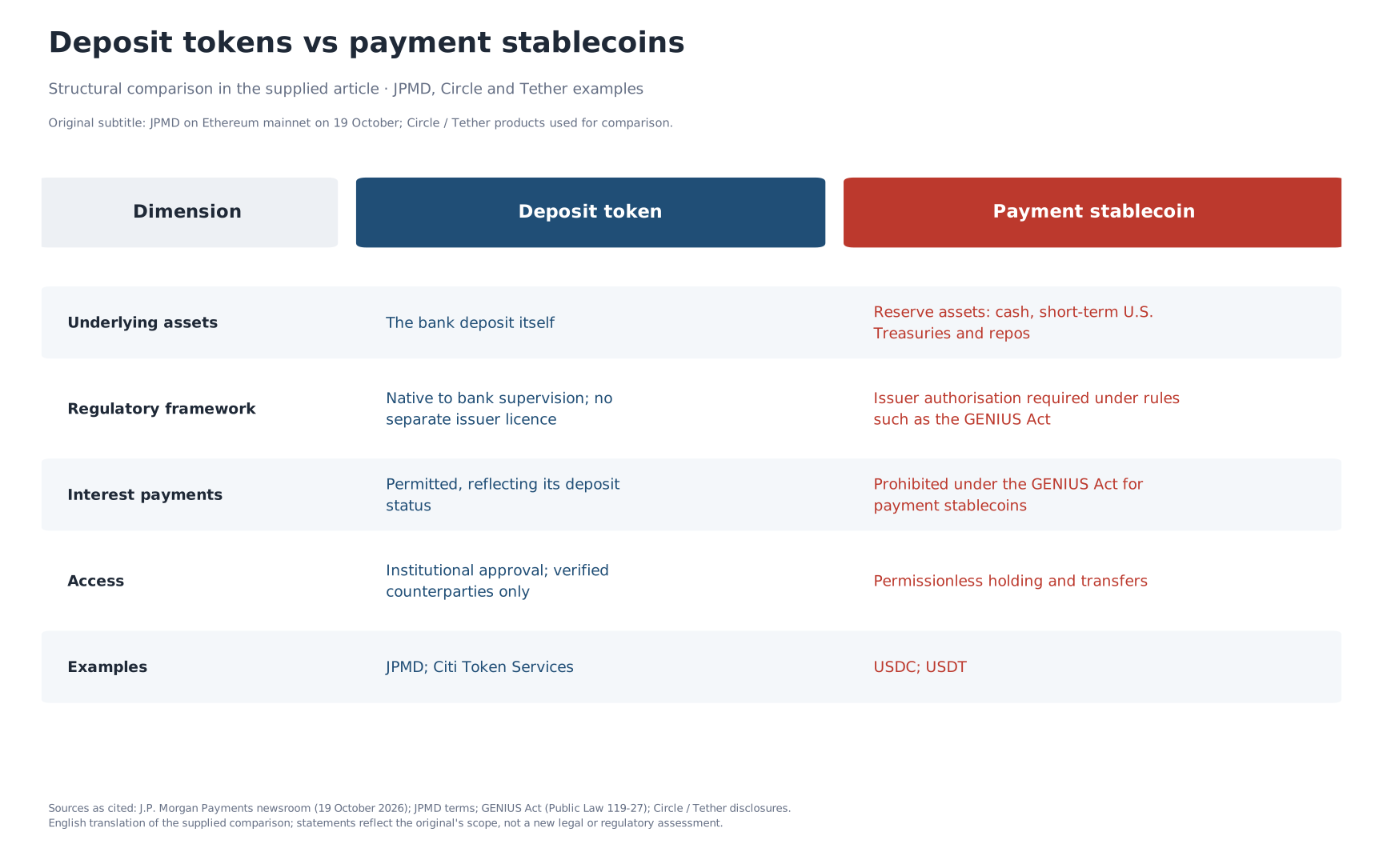
Structural comparison in the supplied article · JPMD, Circle and Tether examples. Original subtitle: JPMD on Ethereum mainnet on 19 October; Circle / Tether products used for comparison.
Underlying assets — Deposit token: The bank deposit itself. Payment stablecoin: Reserve assets: cash, short-term U.S. Treasuries and repos.
Regulatory framework — Deposit token: Native to bank supervision; no separate issuer licence. Payment stablecoin: Issuer authorisation required under rules such as the GENIUS Act.
Interest payments — Deposit token: Permitted, reflecting its deposit status. Payment stablecoin: Prohibited under the GENIUS Act for payment stablecoins.
Access — Deposit token: Institutional approval; verified counterparties only. Payment stablecoin: Permissionless holding and transfers.
Examples — Deposit token: JPMD; Citi Token Services. Payment stablecoin: USDC; USDT.
Sources as cited: J.P. Morgan Payments newsroom (19 October 2026); JPMD terms; GENIUS Act (Public Law 119-27); Circle / Tether disclosures.
English translation of the supplied comparison; statements reflect the original's scope, not a new legal or regulatory assessment.
Deposit tokens versus payment stablecoins.
Figure: Structural differences between deposit tokens and payment stablecoins. Sources cited in the original: J.P. Morgan’s official newsroom, the GENIUS Act, and Circle/Tether public disclosures.
The supplied commentary describes activity beyond J.P. Morgan. It cites Citi’s September 28 announcement that its token services were expanding to Japan and the United Arab Emirates, bringing coverage to seven markets: the United States, Ireland, Hong Kong, Singapore, the United Kingdom, Japan and the UAE. The tokenized-deposit network uses a private permissioned blockchain. The announcement’s stated scale was only that it continued to process “billions of dollars” in transactions; it did not disclose client numbers or market-by-market volumes. The article also describes SoFiUSD’s launch on Ethereum in December 2025 as the first public-chain stablecoin issued by a U.S. national bank. The issuing bank is within the FDIC deposit-insurance system, but the token itself is not FDIC-insured. According to the original, SoFiUSD expanded to Solana in April 2026 and targets the company’s approximately 15 million app users. It further cites HSBC’s April 10 approval for a Hong Kong Monetary Authority stablecoin-issuer license, number FRS02—one of only two in Hong Kong—and its plan to launch the Hong Kong dollar stablecoin RedCoin in the second half of 2026, connecting it to PayMe, with 3.3 million users, and the HSBC HK App. Finally, the article cites The Wall Street Journal’s initial report in May 2025 that J.P. Morgan, Citi, Bank of America and Wells Fargo were discussing a joint stablecoin arrangement through The Clearing House and Early Warning Services; it describes those discussions as still progressing at the April update referenced in the original.
In the April 6 annual shareholder letter cited in the original, Jamie Dimon made the direction explicit. In translation, the passage quoted in the supplied article reads: “A whole new set of blockchain-based competitors is emerging, including stablecoins, smart contracts and other forms of tokenization … We need to roll out our own blockchain technology.” The article’s assessment is clear: the institutional clients stablecoins most want to serve are precisely those best covered by bank credit. The banks now have the licenses and capabilities; what they still need is onchain payment volume.
4. Do not overlook the fourth force: platforms controlling the procurement entry point
Further upstream than “who issues the token?” is another question: “who decides what gets bought?”
The original cites an August 19 Stripe announcement agreeing to acquire OpenRouter, a platform that routes AI models according to cost, performance and reliability. Alongside Tether-backed AIsa, Tempo’s Machine Payments Protocol (MPP) and Coinbase’s x402 protocol, these businesses are not necessarily competing for the same settlement rail. They are positioning at different layers: model routing determines “what to buy”; billing systems determine “how to account for it”; payment protocols determine “how a payment is expressed”; and wallets and settlement layers determine “how the money moves.” A platform can span several layers and still use another company’s stablecoin.
The implication is that even if USDC or USDT processes more payments, issuers may not capture a proportionate share of the economics when customer relationships and fees remain with model gateways, merchant platforms or payment orchestrators. The more consequential threat may be a platform controlling procurement, rather than another token. In the original’s reading, Circle’s software stack—CPN, Arc and Gateway—is also an attempt to move up toward this layer.
5. Our assessment: the seven-cent war is about who can be replaced
Seen together, the four forces are applying pressure in different places:
- Tether is competing for incremental use cases, including Latin American banking access and AI payments. That does not, in the article’s near-term assessment, undermine USDC’s institutional core. But volatility in Tether’s own reserve portfolio—the derived negative second-quarter financial result of $4.211 billion—shows that an installed base is not free.
- Full revenue-sharing models are competing for channel loyalty. If channels are willing to promote an asset in return for 100% of the economics, Circle’s 59-cent allocation must come with a convincing explanation of the additional value it provides.
- Banks are competing for Circle’s most valuable customers. USDC’s central proposition is a compliant, institutional-grade dollar. The original argues that JPMD offers higher credit quality, a more native regulatory position and the possibility of paying interest. Circle’s response is to deepen its service offering—its CPN payments network, Managed Payments and Arc execution environment—so that institutions buy an entire workflow rather than a token. In this assessment, banks do not yet have that complete stack, but their credit standing is already established.
- Procurement platforms are competing further upstream. The settlement currency may be the easiest component to replace.
We therefore update the “two leaders coexist” assessment. The structure has three and a half layers: issuers, channels and banks, plus procurement platforms moving into position. All four are competing for the same thing—the default place in an enterprise payment workflow. Growth in issuance no longer automatically means stronger issuer bargaining power. Channels can switch assets on a client’s behalf; bank entry means compliance is no longer an exclusive Circle selling point; and procurement platforms increasingly want to decide which currency the client uses in the first place.
Three scenarios for the next 12–24 months follow. These are conditional extensions of the baseline research, not probability-weighted forecasts:
| Scenario | Trigger conditions | Implications |
|---|---|---|
| Two leaders coexist; platforms control routing | Multi-asset access becomes widespread and partners resist being locked into a single issuer. | Both issuers grow, while channels negotiate a larger share of the economics. |
| Institutional adoption tilts toward USDC | Circle’s local connections turn into recurring payments, and regulatory and integration advantages translate into retention. | USDC gains a strong position in new formal payment workflows, without displacing USDT’s trading network. |
| Tether fills the formal-interface gaps more quickly | Regional partners generate repeat transactions, while entity-level and audit disclosures meet procurement requirements. | Existing liquidity extends into institutional business. USDT, USA₮ and investment returns must still be distinguished. |
The tests for Circle are specific: whether the plan for 40 emerging markets—a management statement without a country-by-country list—converts into repeat payments; actual payment retention on CPN; and whether the RLDC margin can keep rising as channel bargaining intensifies. For the industry as a whole, there is one decisive benchmark: the ultimate unit of competition is the risk-adjusted net contribution from one customer, one payment route and one holding period—not token price, market capitalization or the number of partnership announcements.
Seven cents is not an inherent flaw. Seven cents, pressure on three fronts and a fourth force moving into position: that is the real opening of this war.
Principal sources, as cited in the supplied original: Circle’s Q2 2026 earnings disclosures and SEC Form 10-Q; Circle’s blog post “The Economics of USDC and Why Our Partners Win” (October 16, 2026); Tether’s second-quarter press release and BDO reserve reports (June 30, 2026 reporting basis); Global Dollar Network’s announcement (July 2026); J.P. Morgan Payments’ official newsroom, “Kinexys Brings JPM Coin Deposit Token to Ethereum” (October 19, 2026); Jamie Dimon’s 2026 annual shareholder letter (April 6, 2026); Congressional Research Service report IF13174 and TBAC’s April 2025 assessment; Citi’s official announcement (September 28, 2026); SoFi’s official announcements and product terms (from December 2025); HSBC Hong Kong’s official announcement (April 10, 2026); The Wall Street Journal’s reporting on the bank consortium (first reported in May 2025); and Stripe’s announcement (August 19, 2026).
Produced by RWA Space. Figures derived from BDO reports, ratio calculations and illustrative estimates are identified as such. Institutional self-reported data not independently verified is attributed to the reporting institution. Do not use this article as a basis for decisions.
Professional English adaptation of the supplied Chinese commentary. Its dated corporate claims, regulatory descriptions, reported figures, calculations and estimates are preserved with their original attribution and have not been independently verified for this edition. Data-reference dates are not treated as the article’s original publication date. The English edition recreates the supplied charts with English labels and the same figures; the Chinese originals remain unchanged in the Chinese edition.