Solana in Shanghai: Looking Past the Bund’s Lights to Its Execution-Layer Strategy
Data as of 16 October 2026 (DefiLlama snapshots, official announcements and disclosures by licensed institutions). Industry commentary; not investment advice.
RWASpace’s opening view: The signal in the Shanghai office opening and the four-city accelerator is less “a blockchain has arrived” than the role Solana is claiming for itself: the execution layer for internet capital markets. The original commentary argues that three strands—RWA, stablecoin payments and compliant settlement—have taken shape in Asia. Ecosystem progress and regulatory boundaries nevertheless require separate assessment.
1. Reconstructing the events: four cities in one week, a strategic commitment rather than a scouting trip
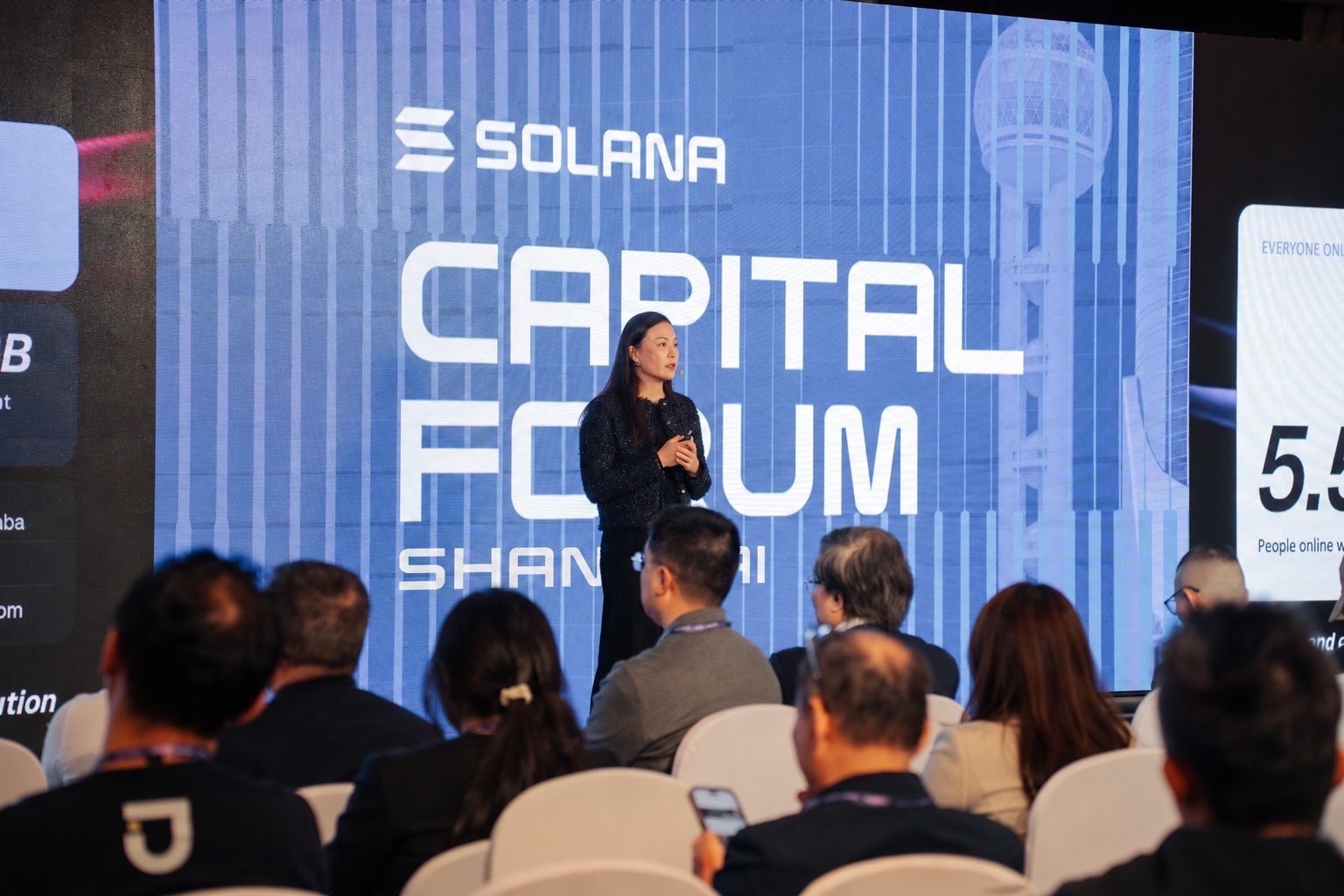
The supplied account dates the formal opening of Solana’s Shanghai office in Lujiazui to October 14, 2026. It reports that the Solana logo lit up the entire Citigroup Tower in Lujiazui that day, while the official X account posted “Hello Shanghai”; the post reportedly received more than 320,000 views. Foundation President Lily Liu reposted the announcement and confirmed the location, describing it as “the world’s highest commercially available office space.”
The original image is not available for translation review. Open source image
Solana’s Shanghai office illuminated
Figure: Citigroup Tower in Lujiazui illuminated with Solana branding. Source cited in the original: the official @solana X post, republished by TechFlow.
More revealing, in the commentary’s assessment, was the pace of the follow-through. Alongside the office opening, Solana announced its four-city Accelerate program in China: Shanghai on October 16, Hangzhou on October 18, Shenzhen on October 20 and Beijing on October 22—four stops within a single week.
The original image is not available for translation review. Open source image
Official Accelerate China key visual
Figure: official Accelerate China key visual. Source cited in the original: solana.com/accelerate/china.
The Shanghai agenda covered Qwen Agent, robotics, Physical AI, embodied intelligence, with Fudan University participating, as well as stablecoins and on-chain payments. The commentary reads that agenda as a signal about the intended audience: Chinese AI engineers, hardware teams and businesses expanding overseas, rather than retail traders. Its interpretation is that Solana wants to connect China’s product and engineering capabilities to its global liquidity network. That is an ecosystem-expansion strategy, rather than a trading business.
The original image is not available for translation review. Open source image
Official Shanghai agenda
Figure: the Accelerate China Shanghai agenda. Source cited in the original: solana.com/accelerate/china/agenda.
2. Positioning: Solana and Ethereum are competing for different roles
The conventional market narrative often reduces competition between blockchains to a contest over token prices and market capitalization. Examining how the two networks allocate resources, however, suggests that they are seeking different strategic positions:
- Ethereum: its central position is in asset standards and settlement security. The original cites approximately $49.4 billion in DeFi total value locked, the largest in the industry, from a DefiLlama snapshot dated October 16, 2026. It characterizes Ethereum as the default compliance anchor when institutions issue assets on-chain.
- Solana: its central position is a unified execution environment. Swaps, lending and payments can be completed atomically within a single transaction, with the entire transaction rolling back if it fails. Its stated ambition is to be “the execution layer for internet capital markets.” An analogy offered in the original is that Ethereum is building clearing standards, while Solana is building the matching and execution system.
This difference in positioning shapes their respective appeal to RWA issuers. It also helps explain, in the commentary’s analysis, why Solana’s institutional narrative over the preceding two years has focused on payments and settlement, rather than on “overtaking Ethereum.”
3. The data foundation: evidence cited for the execution-layer thesis
Positioning needs to be tested against data. The original presents the following Solana metrics as of October 16, 2026, citing the rolling 24-hour snapshot in DefiLlama’s cross-chain overview:
| Metric | Solana | Comparison | Interpretation |
|---|---|---|---|
| 24-hour DEX trading volume | $2.12 billion | Ethereum: $1.36 billion | Activity in on-chain spot execution |
| 24-hour application revenue | $4.23 million | Ethereum: $2.06 million, excluding L2s | Application revenue is not blockchain net profit |
| On-chain stablecoin balance | $15.85 billion | — | The outstanding balance underlying the payments thesis |
| Total on-chain RWA | More than $4 billion | — | Solana’s official RWA report, as of October 2026 |
The commentary considers institutional developments more informative than the headline metrics:
- Visa is reported to have begun settling USDC on Solana, with settlement banks Cross River and Lead Bank cited in a Visa press release dated December 16, 2025.
- BlackRock’s BUIDL fund is described as deployed on-chain; JPMorgan and State Street are also described as having issued assets on-chain.
- The original cites solana.com/upgrades/alpenglow for a scheduled Alpenglow activation on October 21, 2026, at epoch 1064, and a reduction in transaction finality from 12 seconds to approximately 150 milliseconds. The commentary interprets that figure as targeting a payments-grade user experience, and as an explanation for Solana’s repeated emphasis on the “execution layer.”
For readers following RWA, the commentary draws the following implication from these figures and examples: an execution layer with access to Visa-level settlement, a record of institutional asset issuance and a stated 150-millisecond finality target is becoming a serious infrastructure option for RWA issuance and circulation. It sees particular relevance in use cases favoring high-frequency, small-value and payment-oriented assets.
4. The Asian map: Hong Kong, Seoul, Tokyo and Shanghai
Taking a wider view of the first half of 2026, the original commentary presents Solana’s Asian compliance-oriented initiatives as a clear timeline:
- Hong Kong: OSL is described as obtaining Hong Kong’s first authorization for retail SOL trading. The SOL/HKD pair reportedly went live on August 11, with Futu following in parallel. The sources cited are OSL’s announcement and a Sinolink Securities research report from August 2026.
- Seoul: Shinhan Card, described as one of South Korea’s largest credit-card issuers with approximately 28 million cardholders, reportedly signed an MOU with Solana for a stablecoin-payments pilot connected to the central bank’s CBDC deposit-token system. The original cites The Korea Herald and BSC News, April 2026.
- Tokyo: the commentary cites SBI Holdings’ investor-relations announcement of July 13, 2026, for the designation of Solana as its main network for institutional stablecoins, with work on yen-denominated stablecoin issuance and RWA tokenization.
In the original’s strategic interpretation, the Shanghai office and four-city accelerator add the developer and industrial component after Hong Kong, Seoul and Tokyo. Financial licensing sits in Hong Kong; the consumer-payments pilot is in Seoul; institutional stablecoin issuance is in Tokyo; and engineers and practical use cases sit in mainland China. These four pieces remain distinct, but the commentary sees them pointing toward a shared end-state hypothesis: an Asian on-chain capital market.
5. Opportunities and boundaries: industrial demand and regulatory red lines
The industrial opportunities identified in the commentary are concrete:
- AI teams seeking a global payments and settlement foundation, corresponding to the Agent and stablecoin-payment themes on the Shanghai agenda;
- Developers entering the SVM ecosystem and contributing to the execution-layer toolchain;
- Businesses expanding overseas exploring cross-border settlement and asset-tokenization routes.
The regulatory boundaries are equally specific:
First, the commentary’s assessment is that the mainland regulatory framework has not changed. It cites Document No. 42, issued by the People’s Bank of China and seven other authorities on February 6, 2026, as continuing to prohibit businesses that exchange fiat currency and virtual currencies. Leasing an office is not equivalent to obtaining a license; illuminating the Bund is not evidence of regulatory easing; and the permissions held by licensed institutions in Hong Kong do not extend to mainland business.
Second, the commentary rejects promotional narratives such as “the authorities have entered the market” or “a bull-market signal” as inconsistent with its account of the facts. It characterizes Solana’s activities as technical-ecosystem development and developer operations, with no reliable causal chain connecting them to secondary-market prices. Technical exchange and financial business should therefore be assessed separately.
6. Conclusion
The significance of this episode, in the original’s conclusion, is not that a blockchain company leased office space in Shanghai. The question worth following is whether the triangle of “high-performance execution layer + Asian compliance pilots + Chinese industrial capabilities” can hold together. Actual project delivery over the following 6–12 months is proposed as the test. RWA Space states that it will continue to track projects emerging from the four-city accelerator and on-chain data after the Alpenglow upgrade.
Data sources at a glance
| Data or development | Figure or description | Source cited in the original |
|---|---|---|
| DeFi TVL, Ethereum | $49.4 billion | DefiLlama snapshot, 2026-10-16 |
| 24-hour DEX volume | SOL: $2.12 billion; Ethereum: $1.36 billion | Same snapshot |
| 24-hour application revenue | SOL: $4.23 million; Ethereum: $2.06 million | Same snapshot |
| Stablecoin balance | $15.85 billion | Same snapshot |
| RWA | More than $4 billion | Solana official RWA report, as of October 2026 |
| Visa settlement | USDC through Cross River / Lead Bank | Visa press release, 2025-12-16 |
| Alpenglow | 150 ms finality; 2026-10-21 | solana.com/upgrades/alpenglow |
| Shinhan Card MOU | Pilot involving a cardholder base of 28 million | The Korea Herald / BSC News, April 2026 |
| SBI collaboration | Yen-denominated stablecoins and RWA | SBI Holdings, 2026-07-13 |
| OSL authorization | Hong Kong’s first authorization for retail SOL trading | OSL announcement, 2026-08-11 |
| Document No. 42 | Prohibition on fiat–virtual-currency exchange | People’s Bank of China and seven other authorities, 2026-02-06 |
Produced by RWA Space. This is industry commentary; the original identifies the sources of its data. Please credit the source when republishing.
Professional English adaptation of supplied Chinese commentary. The original specifies a data basis of October 16, 2026; this is a reference date. The publication date displayed separately was supplied by the site owner. Reported events, metrics, regulatory descriptions, estimates and forward-looking claims retain the original’s attribution and have not been independently verified for this adaptation. The original’s three external image links are retained. Their source files were unavailable for this edition, so English source cards and the original links appear at the corresponding figure positions rather than unreviewed image embeds.